
Altair Insight: Outlook Good (4Q2025) – Quarterly Market Review
DOWNLOAD THE FULL REPORT
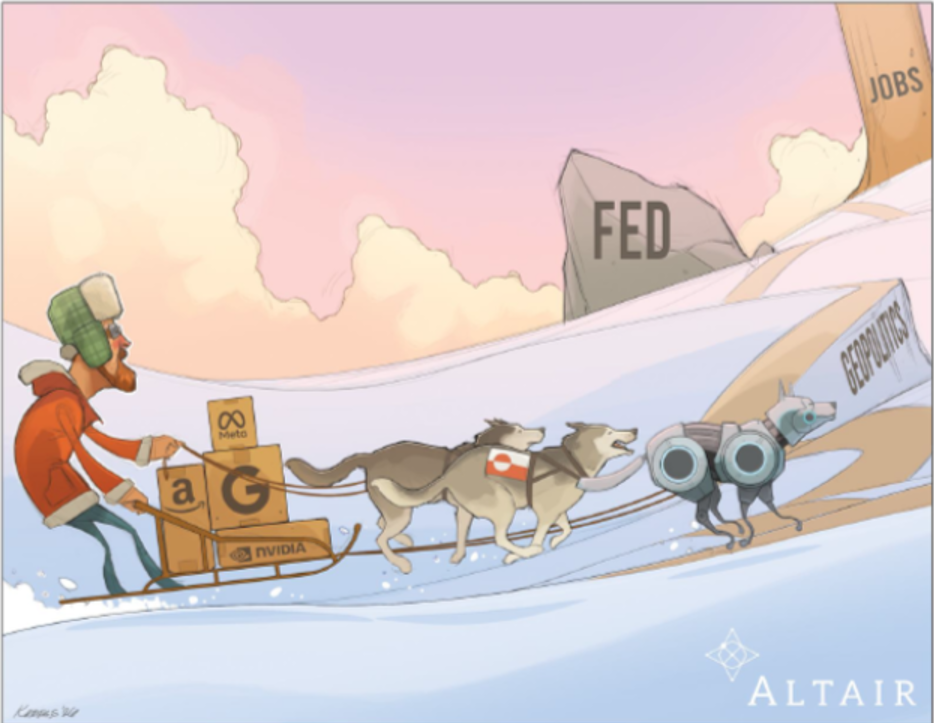
AI is likely to remain a key driver for stocks in 2026, but the weight of mega-cap tech complicates the trail ahead amid domestic and global challenges.
Who would have thought back in April, when the onset of tariffs on “Liberation Day” sent U.S. stocks plummeting to the brink of a bear market, that by year-end those same stocks would have gains for the year close to 20%?
But as crazy as it sounds, it actually happened. And the chaos of ever-shifting tariffs was hardly the only obstacle to overcome – 2025 also saw U.S. military action and threats (Iran, Venezuela, Greenland), unrest in major cities over immigration enforcement, a record-long government shutdown, escalating uncertainty around the Federal Reserve’s future independence and more. With a nod to the next Winter Olympics in Italy just around the corner, if the year were a skiing event, it would mash together the downhill, a bouncy moguls run and catching extreme air in the halfpipe.
And with a solid 2.6% gain in the fourth quarter, stocks stuck the landing.
The market has now posted three straight years of double-digit returns – for 2023 through 2025, the S&P 500 climbed a cumulative 86%. It is among the strongest three-year performances ever for the index.
So, what comes after a triple-double?
While January is off to a rollicking start, on a rolling basis, four straight up years for the S&P 500 is fairly common but four straight double-digit up years is rare. There have been three such occurrences in the past century, each tied to an epic theme – the U.S. entry into World War II, the global post-WWII recovery and the rise of the internet in the 1990s.
Could the advent of artificial intelligence be the next such transformational catalyst? “Yes!” according to its many ardent evangelists. Time will tell just how much long-term impact AI has, but over the shorter term – specifically 2026 – we expect the hundreds of billions of dollars committed to AI-related projects will maintain the technology’s core position as an economic and market driver.
Our optimism for 2026 is not riding on AI acceleration alone. We expect solid GDP gains, generated by a broad range of sources, as the foundation of our outlook. Moderating inflation, a stabilizing labor market, declining interest rates and favorable government policies should all contribute to growth. Outside the U.S., we foresee another year of economic expansion that leads to strong returns for international stocks. Taken as a whole, we believe the outlook for 2026 is good.
We invite you to read on for a more detailed discussion of our views on key issues for the economy and markets.
1. The U.S. economic outlook is looking brighter in 2026 as declining interest rates and fiscal stimulus are expected to add vigor to AI’s continuing buildout.
Economic expectations for the fourth quarter of 2025 are buoyant – the Federal Reserve Bank of Atlanta’s GDPNow latest estimate is that the U.S. economy expanded by 5.4% in the final three months of 2025 as a result of a narrowing trade deficit and higher-than-expected spending by consumers, businesses and governments.
GDPNow’s forecast is well above the market consensus and likely is above the first official reading that will be released in late February. But if this forecast is even close it would be the sharpest upswing in a quarter under normal conditions since 2014 (the V-shaped rebound following after the 2020 pandemic lockdown ended was not normal conditions). If a percentage point or so is ultimately shaved away, our view that the domestic economy is on solid footing would still hold.
First, there is no indication that the AI buildout is losing steam. The St. Louis Fed estimates that AI-related outlays alone accounted for nearly a full percentage point of real GDP growth in the first nine months of 2025. The biggest players – the so-called “hyperscalers” – spent hundreds of billions of dollars last year on setting the foundation for AI’s future and, based on their public announcements, they plan to escalate the pace of investment. Morningstar estimates that AI-focused capital expenditures by the hyperscalers will top $450 billion in 2026, up 20% year over year.
In addition, the biggest economic benefits of the One Big Beautiful Bill Act (OBBBA) enacted last summer came with a time delay that triggers in 2026. Strategas Research calculates that federal income-tax refunds will be $150 billion higher than a year earlier, and that the bulk of that money will be spent rather than saved. And businesses stand to save more than $200 billion this year because of the OBBBA’s more generous rules governing depreciation and expensing.
The Fed has also approved a broad change to capital requirements for the biggest banks that takes effect in April. The change makes many billions of dollars in reserves available for lending, which could help hasten the decline in mortgage rates (in January, mortgage rates dropped to their lowest since late 2022). Existing home sales rose more than 5% in December, according to the National Association of Realtors – it was the largest monthly increase since early 2024 and the fourth straight month of higher sales. The real-estate group predicts that home sales will grow 14% in 2026.
And we envision the Fed will keep cutting short-term interest rates this year. We get deeper into the issue in the next section, but in brief, we believe inflation is under control (even if it is higher than the Fed’s 2% target) and that the central bank will be focused on using its policy tools to shore up the jobs market. But lower rates should stimulate deal activity and further lift IPOs and mergers and acquisitions after relatively lackluster years.
The initial unemployment report for December was 4.4%, down from 4.6% in the previous month, and wage growth was up compared to recent months. That is the good news: The less-good news is that the economy created fewer than 600,000 new jobs in 2025, the lowest in a non-recession year in more than two decades.
This “low-hire, low-fire” labor market certainly is a concern. It is not clear that we have seen the full impact of the Trump administration’s tariff policy on consumer prices or jobs, particularly in the manufacturing sector.
Other concerns include the K-shaped economy that shows healthy activity for higher-income Americans and more hesitant spending by lower-income cohorts (the boost in tax refunds may mitigate this trend); the federal debt is 120% of GDP and growing; and there are growing geopolitical uncertainties that could affect trade and other parts of the economy.
On balance, however, we see more reasons to be positive than negative about the economy in the year ahead.
2. With inflation a bit above target but anchored, the Fed has room for multiple rate cuts this year to further support the stalled labor market.
The two big questions regarding the Federal Reserve as we enter 2026: (1) Who will be the next leader of the central bank and (2) where are short-term interest rates likely heading in the coming year? The answers to these questions are more intertwined than usual given President Trump’s unabashed quest for rock-bottom rates and what he is publicly demanding of candidates for the position of Fed chair.
Second question first: As it stands now, the Fed’s “dot plot” envisions a single rate cut in 2026, while the market is pricing in a high likelihood of a second cut at some point during the back half of the year. We think that, based on trends in inflation and jobs, there will be at least two 0.25% reductions and possibly a third.
Inflation has consistently been higher than the Fed target of 2% annually, but not by much – December’s reading was 2.7%, roughly its level for most of the year. Many pundits point out that recent shelter data trends – which are lagged – signal that the Consumer Price Index would be near 2% using real-time inputs.
With inflation anchored, the central bank had a freer hand to use rate cuts to support a weakening labor market that we see continuing to be vulnerable in 2026. Unless inflation breaks its anchor, the policy tilt toward jobs should be the priority.
Our view only considers the Fed’s dual mandate of stable prices and maximum employment. It does not take into account the “Trump mandate” animating the first big question posed above.
Since returning to the White House, the president has often advocated a 1% federal funds rate – getting to that level would require the equivalent of 10 quarter-percentage-point cuts from the current range of 3.5% to 3.75%.
Whoever succeeds Fed Chair Jerome Powell in May will have clear marching orders from the Oval Office: Reduce interest rates when the economy is performing well and worry less about any inflation that may result. “The United States should be rewarded for SUCCESS, not brought down by it,” the president posted on his social-media platform in December. “Anybody that disagrees with me will never be the Fed Chairman!”
Is a 1% fed funds rate possible in an economy experiencing well-above-average growth? Sure – if there is anything we all have learned since last January, it is to not underestimate the president’s persistence when he really wants something. Is it even remotely likely that rates will fall anywhere close to that 1% level under current economic conditions? No.
Making money vastly cheaper and then just worrying less about inflation would run counter to the Fed’s mandate to use monetary policy to keep prices from getting out of hand. Compared to recent history, the post-pandemic period qualifies as “out of hand”: The CPI is up nearly 25% since 2021, the highest cumulative increase over any rolling five years since the early 1980s. Rates that were kept too low for too long during the pandemic and its aftermath was a key reason for the inflation jump in 2022. Why repeat that mistake?
The Fed has long viewed its reliance on data for decision-making and willingness to stand up to political pressure as the foundation of its credibility with markets and the broader public. Over the years, we have not always agreed with the Fed’s policy decisions but it is essential for investor confidence that the central bank retain its independence. The U.S. Supreme Court signaled it may share that view based on its questions during recent oral arguments in the case involving Fed Governor Lisa Cook, whom the president is seeking to fire.
Powell has shrugged off an unending stream of insults and threats from a president eager to cast him aside and install someone willing to use easy money to further stoke the economy heading into the 2026 midterms. When the administration in January started a criminal probe of Powell, ostensibly over cost overruns on a Fed headquarters rehab, a broad range of defenders – including key Republicans – quickly rallied to the chair’s side.
A more politically pliable chair could push for more partisan policies, but the chair holds only one of the 12 votes on the rate-setting Federal Open Market Committee. Building a FOMC majority has traditionally been an exercise in persuasion by the chair, rooted in well-supported arguments based on the economy’s needs. “Do as you are told” will not be welcomed as a substitute for facts-first leadership.
3. AI remains a key driver for U.S. large-cap stocks but broader revenue and earnings growth should improve performance across nearly all sectors.
The strong returns posted by U.S. stocks last year – just under 18% for the S&P 500 – can largely be traced back to massive AI-related spending, double-digit earnings growth and an accommodative Fed.
This well-above-average performance on the coattails of two even better years certainly has us alert to stretched valuations, but with 2025’s key performance drivers still in place, we believe that the bull market that started in late 2022 has further to run.
In addition to their impact on the overall economy, AI-related outlays had an outsized impact on U.S. stocks. Just how much impact, you ask? Ten companies in the S&P 500 – the Magnificent 7 group of giant tech companies at the heart of the AI growth story, plus three others – accounted for nearly 60% of the S&P 500’s price gain in 2025.
Some market participants are expressing concern about the Mag 7 and adjacent stocks, often in the context of “Will AI’s eventual payoff justify today’s lofty valuations?” It is too soon to try to answer that question – doing so would be like trying to predict what the internet would become.
Time will of course bring more clarity. While we see AI’s future benefits in enhancing productivity, we are managing risk by resisting the temptation to chase the Mag 7 as it has become an ever larger percentage of the S&P 500 (it is now over 35% of the index, which is higher than peak concentration of the largest tech firms during the dot-com era).
Comparisons are increasingly being made between AI and the dot-com era’s skyrocketing boom and spectacular bust a quarter-century ago. Superficial similarities exist – a transformational technology, fervent hype, seemingly instant billionaires – but we find the key differences more persuasive: At the AI vanguard are large, established companies with diverse business lines and growing profitability – not a Pets.com in the bunch.
Tech is pacing earnings growth for the S&P 500, which is forecast to be 12.4% for full-year 2025, up slightly from the previous year, according to the latest report from FactSet. Early estimates for 2026 show that growth rate jumping to 14.7%, driven largely by AI-related investments and favorable government policies and stimulus. That growth, however, is projected to be broad-based, with all 11 S&P sectors predicted to be positive this year. Solid revenue growth is also expected to continue through 2026.
A potential complicator is that this year features midterm elections – history shows that midterm years can be marked by significant stock volatility. A Morningstar report found that, in 12 of the 25 midterms starting in 1926, stocks saw a pullback of at least 10% within a year preceding the election. But these pullbacks tended to be temporary – share prices were on average 15% higher a year after Election Day. We are also positive on small-cap and international stocks – the next two sections detail our thinking about those asset classes.
4. Small-cap stocks are positioned to come out of the shadows in 2026, thanks to lower rates and more domestic spending that stand to enhance profitability.
Over the past three years, small-cap stocks have posted double-digit returns each year that average out at about 15% annually. That kind of performance record would typically turn some heads, but with the Mag 7’s annual return of 62% and the S&P 500’s at 23% over the same period, love has been lacking for the little guys.
A big part of the reason for the relative underperformance of small caps during this bull market has been high interest rates that weigh on economic activity and raise costs for smaller companies that tend to access capital for growth through direct borrowing from lenders.
With four rate cuts behind us in the current cycle and more likely to come, along with several other positive catalysts, we think 2026 is shaping up to be a stellar year for small caps.
Momentum for small caps has been accelerating during the Fed’s latest rate-cutting cycle. The benchmark Russell 2000 index shot up 17% over the six months ending January 23 (a sizable chunk of that coming in January alone). This increase well outstrips the 8.8% gain for the S&P 500 over the same time.
From a profitability standpoint, lower rates benefit small caps by stimulating consumer spending that boosts revenue, while at the same time reducing costs via cheaper borrowing.
Given our expectations that the Fed will make two or more rate cuts this year, we think this tailwind for small caps stands to pick up speed. The potential bottom-line impact: Consensus analyst estimates from FactSet call for quarterly earnings growth for small caps to exceed 60% year over year in 2026, well above the forecast for large caps.
Altair has maintained an overweight to small caps since 2019 and coming into 2026 we feel strongly that this overweight should be maintained. We also see small caps as valuable portfolio diversifiers as the large-cap index has become concentrated in a small number of companies.
We believe small caps are well-positioned to outperform in 2026, and that our overweight will be a significant contributor to overall portfolio performance this year.
5. Despite new geopolitical risks, international markets remain attractive for their underlying economic strength, valuations, diversification, and a resurgence in Asia.
Investors in international markets got a jolt in the early months of 2025 with the announcement of steep U.S. import tariffs that many feared would impair global trade, growth and stocks. Markets tumbled before recovering en route to a banner year. Could it be déjà vu all over again as we move further into 2026?
New geopolitical turbulence has emerged that has the potential to shake up the global order and threaten the ongoing rally in overseas stocks. The U.S. intervention in Venezuela and “Donroe Doctrine” asserting American hegemony in the Western Hemisphere have raised questions for allies, adversaries and investors alike.
Iran, Cuba and Mexico have been put on notice for possible U.S. military incursions. An emboldened Russia has stepped up attacks on Ukraine. NATO’s future is in jeopardy with the threatened U.S. takeover of Greenland.
It is unclear how long international markets continue to take these new risks in stride. However, we anticipate further momentum from tailwinds that helped lift non-U.S. stocks more than 30% higher in 2025, their best performance in 16 years. While they may not get as large a currency boost from the falling dollar in 2026, developed and emerging markets both stand to benefit from a lower-rate environment and other supportive circumstances:
The global economy’s resilience continues to buoy international markets, defying gloomy forecasts from last year. Global GDP is now estimated to have increased by 3.3% in 2025, the same as 2024, according to the International Monetary Fund. The IMF in January bumped up its 2026 forecast from 3.1% to 3.3% once again, citing surging investment in AI and other technology. Unexpected resilience to the tariffs, bolstered by solid consumer spending and easing inflation, has helped sustain growth.
U.S. tariffs may curb global growth after their impact was blunted by stockpiling in 2025. That said, they have had less of an impact than expected on non-U.S. companies. One reason is that only 20% of the revenue for companies in the MSCI ACWI ex US Index – the best-known performance gauge for markets in developed and emerging-markets countries – is derived from their U.S. sales. This also indicates a potential longer-term opportunity to grow their presence in the U.S. from a low base.
Interest rates are lower than the U.S. in much of the world and declining after a series of aggressive cuts in the past year. The European Central Bank, where the benchmark rate is down to 2%, and others have been cutting actively, which should stimulate more economic activity in 2026. Valuations remain compelling relative to U.S. levels, making entry points attractive. And earnings momentum is picking up overseas amid corporate reforms that can improve companies’ profitability.
Increasing geopolitical complexity scrambles the outlook for flashpoints in Iran, Ukraine, Venezuela and beyond. Defense stocks in Europe and South Korea have risen as a result of a rapid increase in military-related spending by NATO countries less confident in the U.S. as an ally. Any related surge in oil prices could crimp global growth and markets. But the U.S. takeover of Venezuela’s governance and oil industry has not disrupted global oil prices because the country’s output is minimal due to mismanagement, sanctions and damaged infrastructure.
Global diversification does not always reward investors, but it paid off handsomely last year and offers further potential benefits by both sector and region. International markets are less concentrated in mega-cap tech stocks than the U.S. and are more cyclical in nature, helping us to mitigate concentration risks. Financial stocks are the largest sector weight in international developed markets and stand to benefit from lower interest rates. And the tech-led emerging markets (notably China, Taiwan and South Korea) still provide investors with overseas exposure to the high-flying AI trade.
Dollar weakness against other major currencies last year (-9.4%) was a key impetus for international stocks outperforming the U.S. While the downturn has leveled off recently, we see a good chance of further decline. Trump has stated his preference for a weaker dollar as a way to make U.S. goods more competitive against China’s, revive the still-sagging manufacturing sector, and reduce the trade deficit. The heightened uncertainty of early 2026 adds to substantial pressure on the greenback.
We believe international markets have the potential for substantial additional gains this year. Our allocations for international equities remain at target levels.
Our Views:
- AI-related growth that propelled the economy and stocks in 2025 will continue as the Mag 7 and their competitors continue to develop the infrastructure and improve their products. Other sectors are also positioned to perform well behind double-digit earnings growth. We expect periods of volatility, but our clients’ diversified portfolios are designed with the goal of weathering market turbulence.
- Additional economic lift this year will come from provisions of the One Big Beautiful Bill Act. Families stand to gain from significantly higher federal tax refunds, as well as banking deregulation that could help reduce mortgage rates, while businesses will profit from cost savings.
- We envision two or more rate cuts by the Federal Reserve this year to support a worrisome jobs market. In our view, inflation appears anchored – albeit above the Fed’s target rate – so the risk of excessive monetary stimulus is outweighed by the benefits of taking action to keep Americans working.
- International stocks have the right conditions to build on their strong 2025 performance. While geopolitical risks have grown in recent months, the economic fundamentals remain intact: solid GDP growth expectations, a turn in earnings momentum, attractive valuations and the continued upside from a weakening U.S. dollar
- Small cap stocks will catch more of a tailwind as lower interest rates and government outlays add to both revenue and earnings. Relatively attractive valuations compared to large caps should also contribute to the rotation to smaller stocks.
Quotes of the Quarter
- “I actually want to keep you where you are, if you want to know the truth.” — President Trump to National Economic Council Director Kevin Hassett, long considered a frontrunner to become the next Federal Reserve chair
- “If monetary policy is really so tight, we should not see an economy that is exhibiting such resilience.”– Neel Kashkari, President of the Federal Reserve Bank of Minneapolis
- “Choose your heroes very carefully and then emulate them. You will never be perfect, but you can always be better.” — Warren Buffett, newly retired from Berkshire Hathaway, in his final letter to shareholders.
Market Data:
U.S. Stocks
2025 makes it three and counting: The stock market completed a relatively rare three-peat of double-digit annual gains in the fourth quarter. Strong corporate fundamentals, frenzied spending on artificial intelligence and optimism surrounding interest-rate cuts lifted the S&P 500 to a full-year total return just under 18% following gains of 26.3% and 25.0% in 2023 and 2024. It was the sixth time in the index’s century-long history that it registered back-to-back-to-back gains of 10% or more, including two four-peats and even a five-peat in the 1990s. The iShares S&P 500 ETF managed a 2.7% rise in the final quarter despite only a fractional gain in December.
Health-care stocks were the big winners of the quarter (+11.6% as measured by an ETF index), while technology (24.6%) and communication services (23.1%) led the way for the year. Small caps as benchmarked by the iShares Russell 2000 ETF slowed their pace after a sizzling third quarter, adding 2.1%. They nonetheless bounced all the way back from a first-half loss to a 12.7% gain for the year. Value stocks outperformed growth stocks in the quarter; growth still prevailed for the year at the large- (18.3%-15.7%) and small-cap (12.9%-12.4%) levels.
International Stocks
Non-U.S. stocks capped a banner year with another quarter of outperformance against their American peers. The MSCI ACWI Ex-US Index, a barometer of international stocks’ performance based on more than 40 developing and emerging markets, added 4.9% for a full-year return of 32.6% – its best since 2009. The key catalyst was the dollar’s largest annual decline (-9.4%) against other major currencies since 2017. Investor demand for the greenback lessened amid lower rates, challenges to the Fed’s independence, uncertainty caused by Trump’s tariffs, and concerns about the lofty valuations of U.S. tech firms.
The global economy’s surprising resilience despite tariffs also underpinned markets in Europe, Asia and elsewhere. The iShares MSCI EAFE ETF, which tracks stocks in 21 developed markets, gained 4.7% in the final three months of 2025 for an annual rise of 31.6%. Without factoring in conversion to the weakening dollar – the big tailwind for U.S. investors holding international stocks – the full-year increase in local currencies was substantially less at 21.2%. The iShares MSCI Emerging Markets ETF was slightly behind the developed-markets index for the quarter at 3.9% but outdid it for the year with a 34.0% gain. Nearly every foreign market of size surpassed the U.S. in performance in 2025, with Japan, China, South Korea and the United Kingdom among the most notable big gainers.
Real Estate
Real estate investment trusts’ performance sagged at year-end amid concerns the Fed might not be able to cut interest rates substantially in 2026 without keeping longer-term yields elevated. Investors also remained cautious with the job market slowing, given the uncertain impact on real estate. The Vanguard Real Estate Index Fund retreated 2.4% in the quarter, trimming its full-year return to 3.2%.
Hedged/Opportunistic
Investments in publicly traded senior bank loans as benchmarked by the Invesco Senior Bank Loan ETF registered a third consecutive quarterly gain, outperforming bonds and virtually matching stocks’ performance. The gauge for direct lending rose 2.0% to finish the year up 6.9%.
Fixed Income
Bonds saw minimal gains in the fourth quarter amid concerns that the Fed could slacken the pace of interest-rate reductions after quarter-percentage-point cuts in three consecutive meetings to end 2025. The benchmark 10-year Treasury note yield, which dipped under 4% for the first time in a year before climbing back to 4.2% at year-end, reflected the bond market’s skepticism. Full-year bond returns were solid nonetheless.
The Vanguard Total Bond Market ETF, a benchmark for investment-grade taxable U.S. bonds, added 0.9% to finish the year up 7.1%. Tax-exempt municipal bonds as measured by a blend of the Market Vectors short and intermediate ETFs added 1.3% in the quarter for a 4.9% annual return. Both bond benchmarks far exceeded their returns of 2024, when Vanguard Total Bond gained just 1.4% and the muni benchmark rose only 1.8%.
Disclosures
The material shown is for informational purposes only. Past performance is not indicative of future performance, and all investments are subject to the risk of loss. Forward-looking statements are subject to numerous assumptions, risks, and uncertainties, and actual results may differ materially from those anticipated in forward-looking statements. As a practical matter, no entity is able to accurately and consistently predict future market activities. Information presented herein incorporate Altair Advisers’ opinions as of the date of this publication, is subject to change without notice and should not be considered as a solicitation to buy or sell any security. While efforts are made to ensure information contained herein is accurate, Altair Advisers cannot guarantee the accuracy of all such information presented. Material contained in this publication should not be construed as accounting, legal, or tax advice. See Altair Advisers’ Form ADV Part 2A and Form CRS at https://altairadvisers.com/disclosures/ for additional information about Altair Advisers’ business practices and conflicts identified. All registered investment advisers are subject to the same fiduciary duty as Altair Advisers.
Private equity investments have different risks than public equity investments, including subjectivity in valuing investment holdings, less transparency, less regulatory oversight, liquidity restrictions and layered, often higher fees. You should perform your own due diligence before investing in any investment, including private equity investments.
ETFs and mutual funds selected by Altair are intended to approximate the performance of the respective asset class in lieu of an established index. An ETF or mutual fund is generally managed by an adviser and, therefore, can be subject to human judgment while an index is typically comprised of an unmanaged basket of instruments designed to measure the performance attributes of a specific investment category. Unlike indices, the ETFs and mutual funds selected incorporate fees into their performance calculations. There can be no assurance that an ETF or mutual fund will yield the same result as an index. Altair has no relationship with the ETFs and mutual funds selected.
The Cambridge U.S. Private Equity Index is a horizon calculation based on data compiled from 1,683 US private equity funds, including fully liquidated partnerships, formed between 1986 and 2025. The return is a pooled horizon return net of fees, expenses and carried interest. Figures are gross of any Altair Advisers’ fees. The benchmark uses the internal rate of return (IRR) to calculate performance, while public-market benchmarks generally use time-weighted returns. As cash-flow timing impacts IRR calculations, making direct comparisons to time-weighted returns could be misleading. You should not directly compare IRR with time-weighted returns.
Any blended benchmark referenced is comprised of a collection of indices determined by Altair Advisers. Altair Advisers used its judgement to select the indices and relative weightings to be shown, with the objective of providing the user with a meaningful benchmark against which to compare performance. Despite its best efforts to remain neutral in selecting the indices and their relative weightings, the blended benchmark should not be viewed as bias-free as elements of human nature inherently played a role in selecting the components of the blended benchmark.
The Closed-End Fund Blended Benchmark consists of 60% First Trust Equity Closed-End Fund TR USD Index, 20% Invesco CEF Income Composite ETF, and 20% VanEck Vectors CEF Municipal Income ETF.
The Securitized Credit Benchmark consists of 65% iShares MBS ETF and 35% iShares iBoxx $ High Yield Corporate Bond ETF.
The U.S. Municipal Bonds Benchmark consists of 65% VanEck Short Muni ETF and 35% VanEck Intermediate Muni ETF.
©2026 Altair Advisers LLC. All Rights Reserved.