

July Update
Headlines & Highlights
- Iran, U.S talking about peace deal: After a couple of weeks of open warfare, Iran and the U.S. have returned once again to diplomacy as a way to bring the five-month-long Middle East war to an end. As of early August, both sides had at least temporarily stopped firing at each other and their respective allies. Oil prices continued the up and down swings seen since the war began in late February: Brent crude, the global benchmark, spiked to over $100 per barrel in late July as fighting escalated but within a week had slid back to the low $80s on the prospects of resumed peace talks.
- Fed holds steady on interest rates: The Federal Open Market Committee (FOMC) voted to keep short-term interest rates at the 3.5% to 3.75% range at its July meeting, though not without some dissension: Three of the 12 voting members of the committee favored a 0.25% rate increase as a response to higher war-related inflation. Federal Reserve Chair Kevin Warsh has said the Fed is committed to using monetary policy to bring inflation down to its 2% target rate. The bond market expressed skepticism about that commitment – after the meeting, 30-year Treasury yields hit their highest level since 2007.
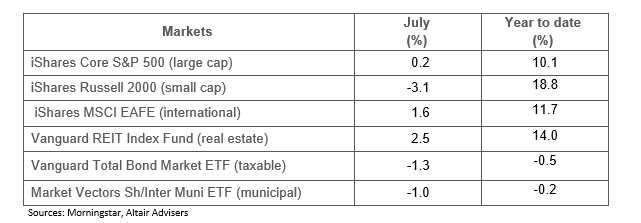
- Markets rebound on Middle East calm: Despite very strong Q2 earnings reports, stocks faced headwinds in July as investors pulled back due to Middle East hostilities and concerns about high AI-related capital spending. At month-end, however, news of new U.S.-Iran negotiations helped the large-cap S&P 500 index recover and end July essentially flat (+10.1% year to date). The small-cap Russell 2000 also rose at month-end but still finished at -3.1% (+18.8% YTD). International developed markets (+1.6% in July/+11.7% YTD) and REITs (+2.5%/+14.0%) fared well in July, while emerging markets lagged at -6.3% (+17.7% YTD). Bonds were pulled down by growing expectations of higher interest rates.
Select Market Returns
Our Views
- The Iran War continues to follow an idiosyncratic pattern of relative quiet punctuated by occasional brief but intense flareups. We believe this recurring trend is evidence that both Iran and the U.S. are feeling economic pain and want to get to peace. Right now, the best first step toward that goal is an end to active fighting and using negotiations to settle smaller issues and build momentum toward a broader peace deal.
- Prospects for peace in the Middle East tend to be reflected most directly in the price of oil – up when the sides are engaged in active fighting, back down when the sides are engaged in diplomacy. We expect oil prices to be volatile until a deal is reached, and that energy will continue to be a key determinant of U.S. inflation levels.
- The Fed’s favored measure of inflation – the core personal consumption expenditures (PCE) gauge – dipped from an annual rate of 3.4% in May to 3.3% in June. Higher oil prices may push July’s inflation numbers back up and add pressure on the Fed to raise short-term interest rates, but our base case is still that the central bank will keep rates at current levels through year-end.
- S&P 500 earnings growth for the second quarter have surpassed even the most optimistic forecasts. As of the end of July, earnings for U.S. large caps were projected to be 47.4% above the same quarter last year – nearly double the growth rate expected just a couple of weeks ago. Fast-rising profits are the main reason for our confidence in U.S. and international stocks this year.
- U.S. economic health is providing a tailwind for stocks. Employment is near historic lows at 4.2%, without significant layoffs. Consumer confidence and spending by businesses – led by the AI buildout – have both been trending upward. Manufacturing activity in July hit a four-year high. These important drivers should continue to support economic growth in the second half of the year.
The material shown is for informational purposes only. Past performance is not indicative of future performance, and all investments are subject to the risk of loss. Forward-looking statements are subject to numerous assumptions, risks, and uncertainties and actual results may differ materially from those anticipated in forward-looking statements. As a practical matter, no entity is able to accurately and consistently predict future market activities. Information herein incorporates Altair Advisers’ opinions as of the date of this publication, is subject to change without notice, and should not be considered as a solicitation to buy or sell any security. While efforts are made to ensure information contained herein is accurate, Altair Advisers cannot guarantee the accuracy of all such information presented. Material contained in this publication should not be construed as accounting, legal, or tax advice. See Altair Advisers’ Form ADV Part 2A and Form CRS at https://altairadvisers.com/disclosures/for additional information about Altair Advisers’ business practices and conflicts identified. All registered investment advisers are subject to the same fiduciary duty as Altair Advisers.
The material shown is for informational purposes only. Past performance is not indicative of future performance, and all investments are subject to the risk of loss. Forward-looking statements are subject to numerous assumptions, risks, and uncertainties and actual results may differ materially from those anticipated in forward-looking statements. As a practical matter, no entity is able to accurately and consistently predict future market activities. Information herein incorporates Altair Advisers’ opinions as of the date of this publication, is subject to change without notice, and should not be considered as a solicitation to buy or sell any security. While efforts are made to ensure information contained herein is accurate, Altair Advisers cannot guarantee the accuracy of all such information presented. Material contained in this publication should not be construed as accounting, legal, or tax advice. See Altair Advisers’ Form ADV Part 2A and Form CRS at https://altairadvisers.com/disclosures/ for additional information about Altair Advisers’ business practices and conflicts identified. All registered investment advisers are subject to the same fiduciary duty as Altair Advisers.